



Actions – Bringing Structure to Your Laravel Business Logic
It's a story every developer knows: a project starts lean, but over time controllers balloon into unwieldy monoliths. As a dedicated Laravel agency, we rely on architecture patterns that keep your software scalable and maintainable for the long haul — encapsulating logic in Action classes so it stays clean and reusable.

What Is a Controller?
Whenever we hit an endpoint in a Laravel application — that is, request a specific URL — the request typically lands in a controller. Technically, the controller acts as the central logic interface: it receives the incoming request, orchestrates the necessary processes within the application, and returns the appropriate response.
In custom software development, the controller is essentially the "conductor" of the system, making sure data is processed correctly and the desired functionality is executed precisely.
The Problem: Why "Fat Controllers" Slow You Down
In the Laravel world, developers often talk about so-called "fat controllers." This means all of the business logic — from validation and database queries to sending emails — lives directly inside a single controller method. What seems efficient at first quickly leads to serious problems as a project grows:
Poor reusability: When logic is baked into a controller, it can't easily be reused elsewhere — say, in an Artisan command or a mobile app. You end up duplicating code, which increases the risk of bugs.
Difficult maintenance: The longer a controller grows, the harder it becomes to navigate. For your agency or internal team, even small changes become time-consuming and expensive because side effects are hard to predict.
Hard to test: Automated tests are the backbone of reliable software. But testing oversized controller methods in isolation is complex and error-prone.
In short: too much code in your controllers makes your application rigid and costly to maintain. That's why we follow the "slim controller" principle — keeping controllers thin to preserve agility and long-term performance.
The Solution: Actions – Focus and Structure for Your Code
To avoid the pitfalls of bloated controllers, we consistently use Actions in our Laravel projects. An Action is a dedicated class that encapsulates exactly one piece of business logic — for example, CreateOrderAction, RegisterUserAction, or UpdateInventoryAction.
Instead of the controller laboriously handling every step itself, it delegates the task to the appropriate Action. This has decisive advantages for the quality of your software:
Single Responsibility: Each Action has one job. This makes the code extremely clear and easy to understand — both for our team and for your in-house developers.
Full reusability: Since the logic is no longer tied to a web endpoint, the same Action can be used seamlessly across your mobile app (iOS & Android), background jobs, or API integrations.
Safe to evolve: This modular structure makes it far easier to update or extend individual parts of your application later without putting the entire system at risk.
That's why we use Actions to build a codebase that doesn't just work today, but remains flexible and cost-effective to scale five years from now.
Efficiency Through Standardisation: The Laramate Support Package
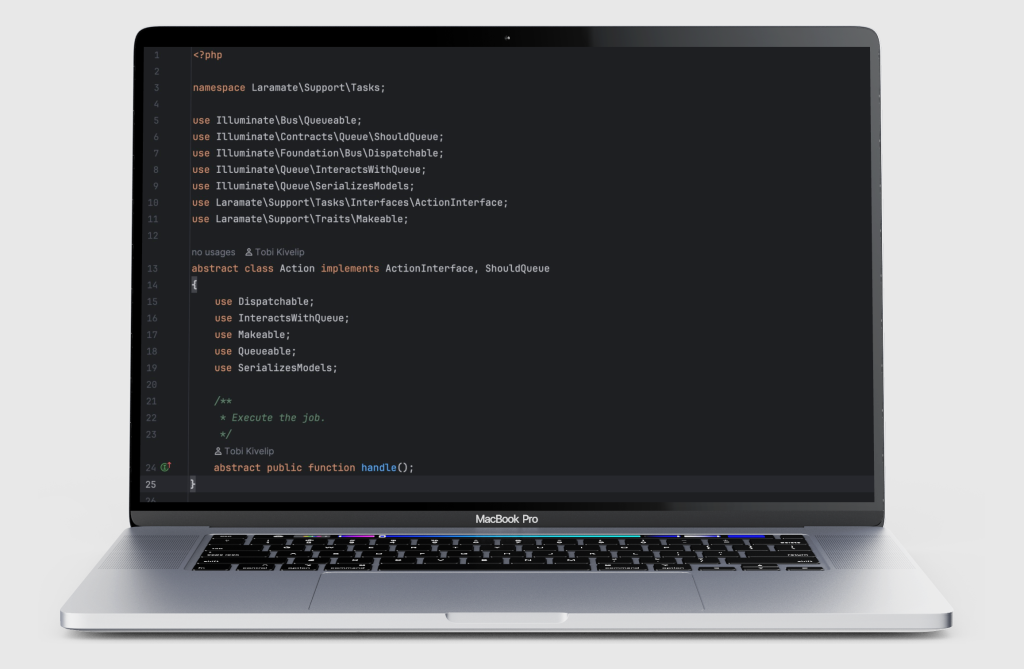
As a specialised Laravel agency, we've developed our own Composer package that provides an abstract Action class. We use it across all of our projects, which means code can be transferred from one application to another in no time. The Laramate Support Package is fully open source and freely available to everyone. It has already been installed over 6,000 times.
The Laramate Support Package integrates seamlessly with Laravel's core: by leveraging native traits like SerializesModels and InteractsWithQueue, our Actions can be dispatched to the queue or processed asynchronously without any extra effort.
No results One result
Too many searches in a short time. The search is not reachable right now.
Please wait a moment, then carry on. Please try again in a moment.