


Dynamic Pricing in Online Pharmacies: How to Take Advantage of Price Competition in Google Search
Ever wondered why the same medication at the same online pharmacy suddenly costs 30% less, just because you accessed it through Google Shopping? What feels like a lucky break for consumers is actually the result of sophisticated dynamic pricing strategies and targeted feed optimization.


Online pharmacies systematically show lower prices to visitors arriving via Google Shopping — often 15–30% cheaper than their standard retail price. The reason: URL parameters reveal the visitor's origin to the backend, and the system automatically switches to competition-optimized pricing.
Dynamic Pricing
In the world of e-commerce, prices are no longer static. Online pharmacies use complex algorithms to adjust their prices in real time based on the acquisition channel. Visitors who navigate directly to the website typically see the standard price — but those arriving through price comparison portals or Google Shopping land in a highly competitive bidding war. The pharmacy's systems trigger special "referrer prices" to stay competitive in the race for the top Google ranking.
As a custom web development agency, we take a look behind the scenes of these mechanisms. In this article, we explain how this pricing system works from a technical perspective, what role product data feeds play, and — most importantly — how you can use this technical "lever" to your advantage on your next purchase.
The match against the price feed
Behind the scenes, online pharmacies work with enormous CSV or XML feeds that are exported to Google several times a day. These feeds do not contain the standard retail prices but tightly calculated battle prices. When the landing page is loaded, the logic in the backend (the so-called business logic) checks:
Are you visiting directly? Show price A (margin-optimised).
Are you coming from Google Shopping? Show price B (conversion-optimised).
Under the Hood: How URL Parameters Control Prices
In short: the URL you use to access a product determines the price you see. The key to the reduced prices lies in the parameters appended to the URL when you click through from Google Shopping. Technically, this is a form of channel-dependent pricing.
As soon as you click on a listing in Google search, a set of parameters is appended to the pharmacy's target URL (e.g., utm_source=google&utm_medium=shopping...). The web application's backend — often built on frameworks like Laravel or specialized e-commerce engines — recognizes these parameters immediately.
Based on this trail, the system knows: this user is actively comparing prices. If the system were to display the standard price here, the bounce rate would be extremely high, since the next competitor is just one click away.
Why Do Pharmacies Do This?
Because the lowest price in Google search gets the most clicks. Pharmacies use this technique to secure the top spot in price comparison results. It is a digital battle of attrition. Since profit margins on over-the-counter medications are typically high enough, they sacrifice a portion of their margin for customer acquisition. The operators' bet: a customer who buys at a discount once might order directly next time (at the higher price) or add other products to their cart that are not listed in the price comparison. Newsletter offers and loyalty programs are designed to retain these customers further and encourage them to buy directly through the provider's website.
Reality check: save 12 euros with a single click
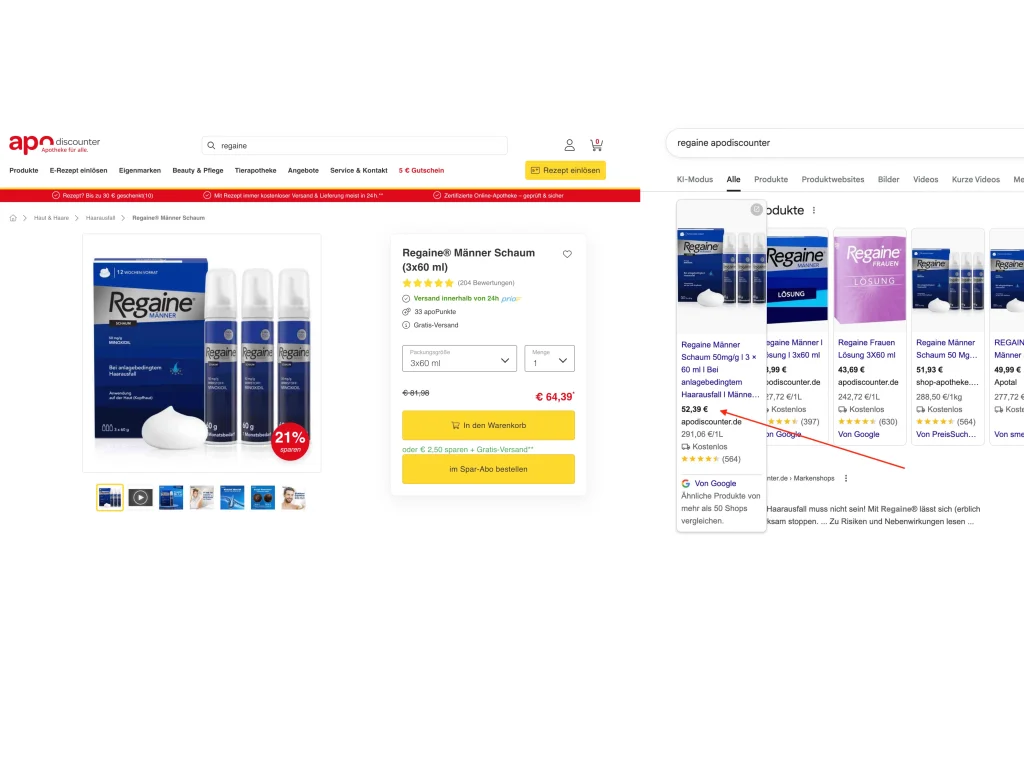
A real-world example — the product "Regaine" at the online pharmacy apodiscounter — illustrates this mechanism in its purest form and shows just how aggressively the algorithms in the background control prices. A direct visit to the website returns a price of €64.39, while a targeted Google search for the product combined with the shop name returns €52.39. With a single click, users save exactly €12.00 from the same provider for the exact same product.
If you want to order several products at once, it is worth repeating this process for each product. Simply search on Google for a combination of the product name and the provider name, as shown in the screenshot.
Transparency notice & disclaimer
This is explicitly not advertising, a purchase recommendation, or a paid partnership. We have no business relationship with the provider shown or with the product's brand, and we do not use the product ourselves. The pricing mechanism documented here is a common industry phenomenon that can be observed with a wide range of online pharmacies as well as with various other product categories and providers.
Conclusion: complexity beneath the user interface
Behind a seemingly simple price display lies a highly complex infrastructure of API interfaces, dynamic price feeds, and intelligent backend logic. This is precisely where our expertise lies: we use Laravel and React to build tailor-made systems that implement complex business rules like these reliably and at scale — whether for e-commerce or custom software solutions. Once you understand how these mechanisms work, you can not only use the web more efficiently, but also better assess the technological possibilities for your own business.
Technologies like dynamic pricing are just a fraction of what is possible on the modern web. Do you need a partner for a tailor-made web solution, or are you looking for in-depth advice on your next project? We will gladly help you turn your vision into a technically flawless reality. Get in touch with us now.
No results One result
Too many searches in a short time. The search is not reachable right now.
Please wait a moment, then carry on. Please try again in a moment.