

No-Code vs. Custom Software Development
No-code platforms promise rapid digitalization without programming skills. Custom software development requires investment but delivers precisely tailored solutions. When does each approach make sense? An honest assessment from real-world experience — with concrete scenarios, cost comparisons, and a decision guide for executives and IT leaders.

The Promises of the No-Code World
No-code and low-code platforms like Bubble, Make (formerly Integromat), Airtable, or Retool are marketed with bold promises: "Build your app without writing a single line of code," "Digitalize your business in an afternoon." And indeed — for certain use cases, these platforms are impressively capable.
No-code shines particularly when it comes to rapid prototypes that let you validate an idea in days rather than weeks. Simple internal tools — such as a form that writes data to a spreadsheet — can be built in just a few hours. For workflow automation following the pattern "When an email arrives, create an entry in Notion," platforms like Make are an excellent fit. And for founders without a technical background, they offer the ability to build an MVP and test a business idea before investing in actual development.
For these scenarios, no-code is the right choice. Period.
Where No-Code Hits Its Limits
The problems begin when the prototype needs to become a production system. Many of our clients come to us after taking exactly this path: what started as a quick solution with Bubble or Airtable became a bottleneck.
Complex Business Logic Is Nearly Impossible to Implement
As soon as rules like "If customer A from industry X places an order over Y EUR and inventory drops below Z, then..." come into play, no-code becomes a patchwork of workarounds. Nested conditions, state machines, and domain-specific validation simply cannot be properly modeled in visual editors.
Performance Under Load Becomes a Bottleneck
No-code platforms run on shared infrastructure. With hundreds of concurrent users, large data volumes, or compute-intensive operations, they hit limits that no upgrade can resolve.
Integration with Existing Systems Remains Difficult
Connecting to your ERP, accounting software, or a proprietary API often requires workarounds, middleware services, or — ironically — a developer writing custom code after all.
Data Sovereignty and Vendor Lock-In
Your business data resides on the no-code provider's servers, often in the US. For GDPR-sensitive applications or industries with compliance requirements, this is a serious concern. On top of that, your entire business logic lives on a proprietary platform. If the provider raises prices, removes features, or shuts down, you have no codebase to take with you.
The Underestimated Risk of Data Loss
A risk that is rarely discussed: your data sits on the provider's infrastructure, and you have no control over backups or failover. If the provider experiences technical issues, your business data could be gone in the worst case — with no way to recover it.
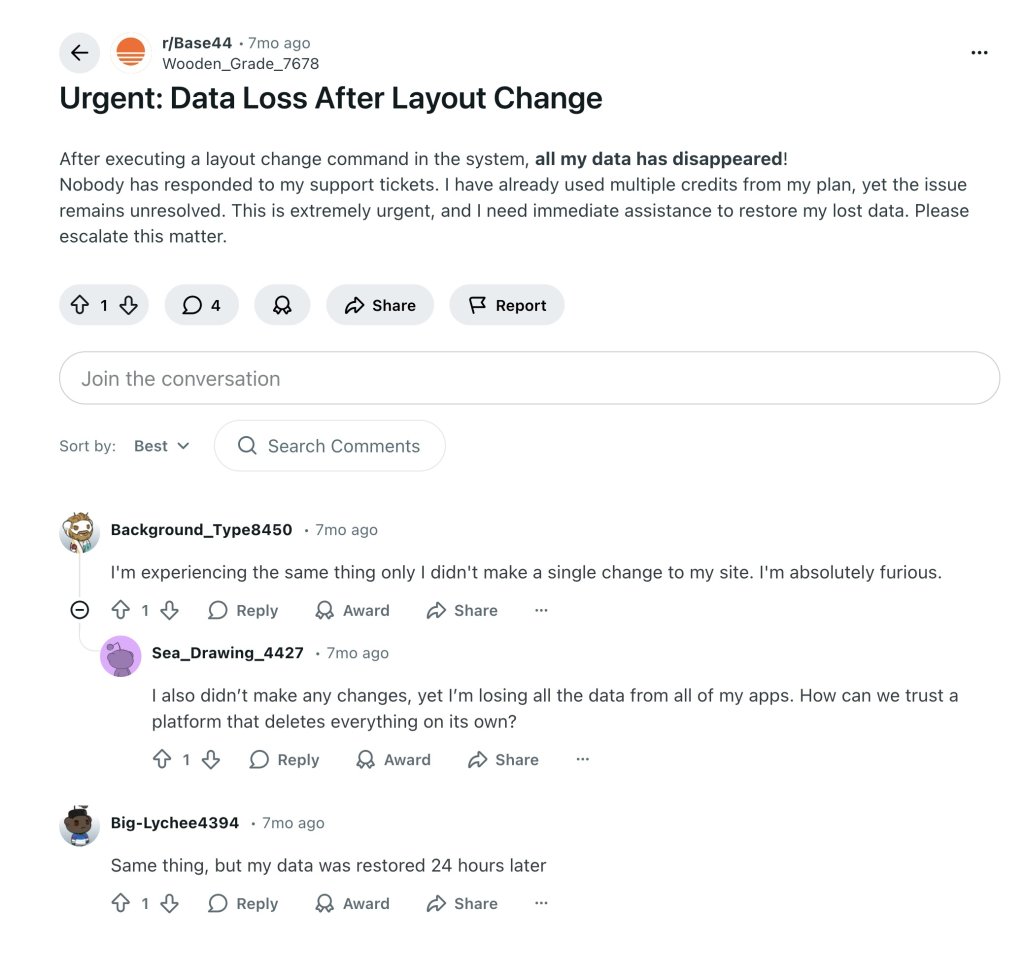
A recent example: reports are piling up on Reddit from users of the no-code platform Base44 who lost their entire projects and data — without warning, without any backup option. This is not an isolated incident but a systemic risk of platforms where you control neither the code nor the database.
With a custom-built solution, you own the database. Backups run automatically, the infrastructure is redundant, and in an emergency, you can always restore from a backup — because you have full control over your system.
The Hidden Costs of No-Code
The biggest myth around no-code is the cost advantage. Yes, the entry point is cheaper. But the total cost of ownership tells a different story.
Recurring License Costs Add Up
No-code platforms cost 50–500 EUR/month. When using multiple tools for database, automation, frontend, and hosting, this quickly adds up to 500–2,000 EUR/month — without actually owning the software.
Opportunity Costs Are Overlooked
The time your marketing team or executives spend assembling no-code workflows is time taken away from your core business. A CEO spending two days a week building in Bubble is an expensive developer.
The Inevitable Migration Costs
When the no-code system reaches its limits, the real investment begins: the business logic must be rebuilt from scratch in code. The previous investment in the no-code solution is then a sunk cost.
Custom Software Development: What You Get in Return
Custom development with a framework like Laravel costs more upfront — that's the honest truth. But you get something in return that no-code simply cannot offer.
A Perfect Fit Instead of Compromises
The software maps your business processes exactly as they are, not the other way around. You don't adapt your workflow to the limitations of a tool — the tool adapts to your business.
Full Control Over Code, Data, and Infrastructure
Code, data, and infrastructure belong to you. No vendor lock-in, no price dictation, no dependency on a third party's roadmap. You decide where your application runs and how it evolves.
Scalability from Day One
A Laravel application can scale from 10 to 10,000 users without rebuilding the system. Horizontal scaling, caching, and queue-based processing are natively supported and grow with your business.
Security, Compliance, and Long-Term Maintainability
GDPR-compliant hosting on European servers, encrypted data, audit logs, and role-based access control — all of this can be implemented precisely to your requirements. Add to that clean code with automated tests that remains extensible years down the line. No technical debt from plugin dependencies or outdated no-code versions.
A Real-World Example from Our Practice
A client came to us after attempting to digitalize their order processing with a combination of Airtable, Zapier, and a Google Sheets backend. The system worked — up to a point. At 50 orders per day, the automation regularly broke down, debugging nested Zapier flows took hours, and integrating with the accounting software required manual intermediate steps.
We replaced the system with a Laravel application that automatically processes orders, generates invoices, and feeds them directly into the accounting system. The error rate dropped to zero, processing time went from minutes to seconds. The client has since been able to focus on their core business again instead of debugging.
The Hybrid Approach: No-Code Where It Makes Sense
The decision doesn't have to be all-or-nothing. In many of our projects, we combine custom-built software with complementary tools where they play to their strengths.
For example, we use n8n for workflow automation, connected to the Laravel backend via API. For content management, we rely on Statamic CMS so editors can manage content independently while the business logic remains in code. And for internal admin interfaces, we leverage Filament admin panels — a visual interface built on a clean code foundation.
The key principle: your core business logic belongs in custom code. Everything around it can be pragmatically solved with the best available tools.
Decision Guide: No-Code or Custom Development?
To make the decision tangible, we built a make-or-buy calculator for software projects that weighs both approaches against each other. The key criteria at a glance:
When No-Code Is the Right Choice
No-code is a good fit when you want to quickly validate an idea as a prototype or MVP and the requirements are simple and standardized. As long as fewer than 50 users are working with the system simultaneously, there's no development budget available, and the solution won't become a business-critical system, a no-code platform is often the faster and more affordable option.
When Custom Development Is the Better Choice
Once your business processes are complex and can't be mapped in off-the-shelf tools, there's a strong case for a custom solution. The same applies when the system needs to scale in terms of users, data volume, or feature scope, or when integration with existing systems like ERP, CRM, or accounting software is required. If data privacy and compliance play a role, or the software is meant to be a long-term competitive advantage rather than just a stopgap, custom development is the more sustainable path.
Conclusion
No-code tools aren't competitors to custom software development — they solve different problems. For rapid prototypes and simple automations, they're the right choice. For business-critical systems that need to grow with your company, they're a risk.
The honest question isn't "What costs less?" but rather "What will this decision cost me in three years?" And in most cases where real business logic is involved, the answer is: a custom-built solution costs less — because it works, it scales, and it's yours.
Not sure which path is right for your project? In a free initial consultation, we'll give you an honest assessment — even if the answer turns out to be "no-code is sufficient for your needs."
No results One result
Too many searches in a short time. The search is not reachable right now.
Please wait a moment, then carry on. Please try again in a moment.