


Is NativePHP ready for production?
With NativePHP, desktop and mobile apps can be developed directly from a Laravel codebase.
This massively accelerates development but hits limits with complex device features. We analyze when NativePHP is the efficient solution and when React Native remains the safer choice for your product.

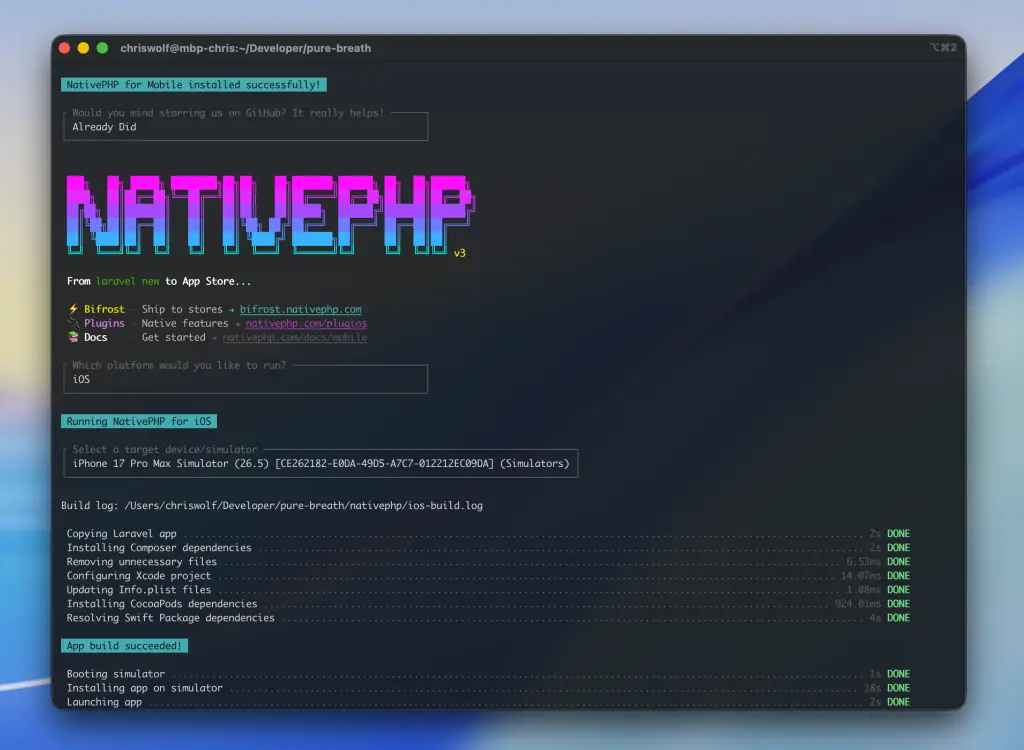
NativePHP makes sense for app projects that require few native device features and where time-to-market is critical.
When high performance requirements must be met or rare device functions need to be used, React Native remains the more robust choice.
What is NativePHP?
NativePHP enables development of desktop apps (for macOS, Windows, Linux) and mobile apps from a single Laravel codebase.
The user interface is built with Blade and Livewire to enable dynamic interfaces.
Under the hood, NativePHP wraps the Laravel app in a native shell and provides bridges to the operating systems functions.
The promise: if you already know Laravel, you can build apps without an additional frontend framework. This makes NativePHP particularly attractive for teams whose strength lies in the PHP ecosystem and who do not want to build separate React Native or Flutter competency.
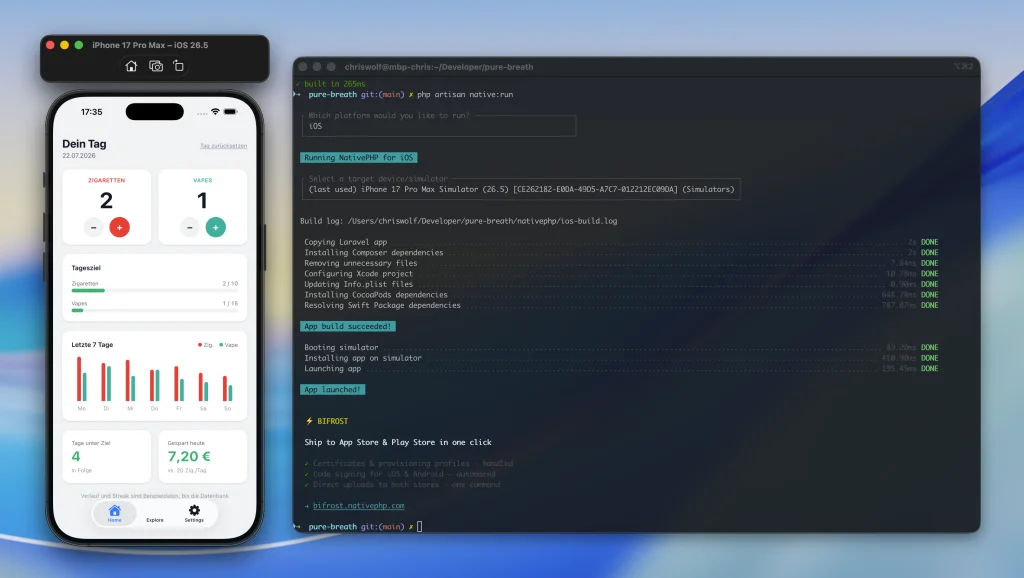
Structure of a NativePHP project
A NativePHP project hardly differs in its structure from a classic Laravel web application. This is one of its biggest advantages: the entire architecture remains consistent.
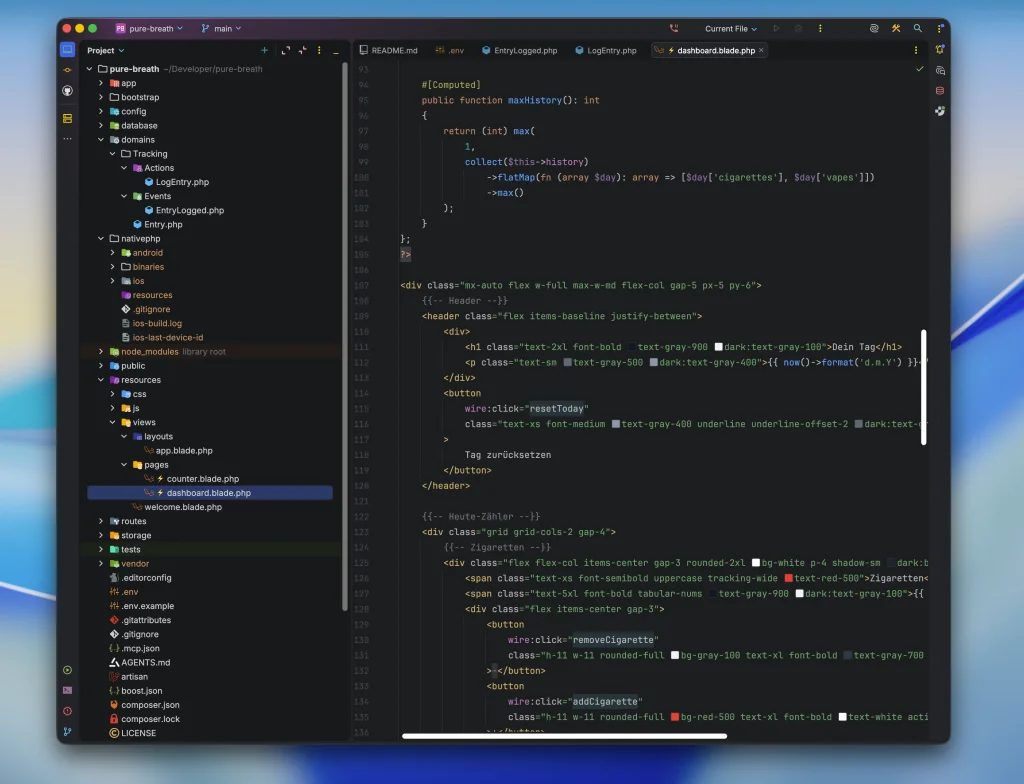
In the backend, we use proven Laravel patterns like domain structures and action classes to cleanly encapsulate business logic and keep it maintainable.
The user interface uses Livewire and Blade components. This means that building the app interface is nearly identical to building a modern web frontend.
Advantages of NativePHP
Low need for device features
For dashboard apps, internal administration tools, or desktop clients for existing Laravel applications, NativePHP is ideal. If the app rarely needs to access native hardware features, you can write all your logic in PHP and put your existing Laravel expertise to work.
Fast time-to-market
For prototypes, pilot projects, or supplementary internal tools, speed is what matters most.
NativePHP enables you to create a working app from an existing Laravel base very quickly, without needing to build an additional developer team for another framework.
Maximum code reuse
Since NativePHP is an extension of your Laravel project, validation logic, domain models, policies, and services can be reused directly. For companies with an established Laravel backend, this is a significant time and cost advantage.
Limits of NativePHP
When many device features are needed
NativePHP supports device features such as camera access, Bluetooth Low Energy, NFC, barcode scanners, background tracking, and push notifications.
The framework is growing quickly, but it is still playing catch-up to React Native, which launched in 2015. This means that some plugins are simply not yet available. For example, as of July 2026, there is no Bluetooth Serial integration. It is also unclear whether continuous data transmission can even work with NativePHPs PHP service architecture.
When performance requirements are high
Complex animations, high rendering pressure, compute-intensive client logic: in such scenarios, you hit NativePHPs limits earlier because the combination of WebView, Livewire, and server round-trip is not designed for every load. For interactive, performance-critical apps, a native or React Native-based approach is often more maintainable.
Advantages of React Native
React Native has been in production use for years by thousands of companies worldwide.
The ecosystem of libraries, tools, native modules, and community knowledge is mature.
With Expo, there is also a delivery pipeline that handles nearly all steps from local development through builds to App Store deployment at low cost.
Even demanding projects that must integrate many or special native libraries can be implemented efficiently with React Native. For app projects with serious product requirements, this remains our first choice.
More about our React Native development services.
Decision aid for your project
There is no blanket answer to "NativePHP or React Native?"
The right decision depends on concrete factors:
How many and which device features does your app need?
How high is the performance demand?
How long should the product run?
What expertise is available in the team?
How important is time-to-market compared to longevity?
This decision should be made at the beginning of a project to avoid double effort.
We continuously monitor the ecosystem and provide current recommendations for each new project, rather than relying on dogmas.
No results One result
Too many searches in a short time. The search is not reachable right now.
Please wait a moment, then carry on. Please try again in a moment.