



Communication Gap Between Problem-Aware Buyers and Solution-Focused Providers
Your job is to generate pipelines and increase revenue. Ours, at Laramate, is to build the technical architecture that makes that possible. If your website functions as both an information resource (what you do, who you’ve worked with, how to get in touch), and an acquisition channel, and you know it needs to perform better but are unsure what needs to change, you might find this piece of writing useful.

Taken literally, acquisition means to take. In marketing terms, however, acquisition has one specific goal: convert and retain prospects. Worldwide, companies are reducing headcount to cut operational costs. Amazon’s decision to cut 16,000 roles, driven largely by automation restructuring, is one example of this broader market shift. As companies reduce headcount, spending on digital acquisition rises accordingly. The expectation behind this spending is that well-built digital infrastructure will do the work that people used to do.
The same pressure applies to your pipeline. Think specifically about what your campaigns sent traffic to last month. Handling that traffic effectively requires a specific set of capabilities:
A lead capture layer with qualification logic and CRM integration;
A configurator or guided inquiry tool for products or services with variable pricing or complex specifications;
Campaign-ready landing pages that marketing teams can deploy without involving a developer at every iteration;
A content management layer that editorial teams can operate independently to support SEO and GEO over time.
Where Most Acquisition Pipelines Break
This pipeline is only as strong as its weakest link. For most companies, that weak link is the website. The questions worth asking:
Does it speak directly to a problem-aware audience?
Was it built for flexibility, or does every minor change require a developer?
Can it support campaign landing pages, content hubs, product configurators, lead forms, and partner portals without disrupting ongoing operations?
What CMS does it run on, and can non-technical teams use it without support?
Remember, none of these are abstract concerns. These questions are solvable, and each feature requirement behind them is buildable.
When traffic from paid or organic channels arrives at a site not built to handle it, the outcome is predictable. Visitors leave because the site is not intuitive, lead forms are complicated, or the landing page has no clear path to contact or convert. To address the upstream issue rather than just the symptoms, my earlier piece, How to do SEO Without Thinking About SEO, covers some foundational principles.
Yet businesses still gravitate toward agencies that speak their language.
A marketing director looking for a partner to build an acquisition-ready website searches in commercial terms: lead generation, digital brand presence, campaign infrastructure, inbound enquiries. Naturally, they select partners whose vocabulary matches their own. An agency that responds with technology rationale, CMS selection logic, Laravel, FilamentPHP, and development methodology may hold equal or greater capability and still not reach the room where the decision is made. The reason is a vocabulary gap, not a competency gap. And, this entirely shapes which agencies get shortlisted.
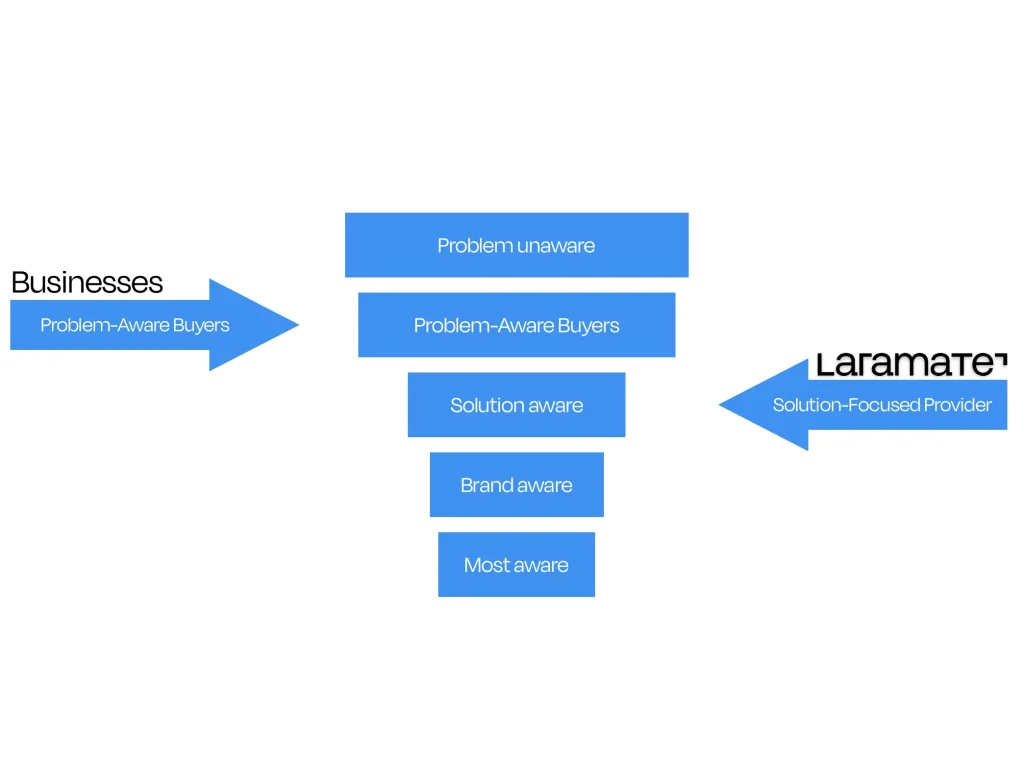
This gap costs businesses on both sides.
In the DACH market in particular, where capable software development agencies often communicate in technical terms, marketing-oriented buyers gravitate toward companies that speak directly to commercial outcomes. But the selection by vocabulary rather than capability, becomes more costly over time: you pay more for output that does not meet the required functionality.
Consider someone who walks into a hardware shop with a problem they cannot name. They know something is broken and what it is supposed to do, but not what the part is called. So they describe it in the best terms they have: the fitting that connects the pipe to the wall, the one that stops the leak. The person behind the counter listens, identifies the problem immediately, and produces the exact part. The customer did not need to know the technical name. The staff member did.
That exchange is the model.
A client describing a need for more inbound enquiries is not asking for a technical recommendation but is asking whether you understand their commercial situation. The software development agency, on the other side, is explaining exactly how it can solve that problem in technical terms. Both are describing the same outcome in different languages.
This dynamic is accelerating.
AI search tools are shortening the discovery phase. Instead of working through multiple websites to form a shortlist, buyers are receiving synthesised answers and direct brand recommendations. Those recommendations are drawn from published content. A provider whose content speaks primarily in technical terms will not be surfaced to a buyer describing a commercial problem.
As a marketing director or sales manager, how do you identify the right vendor to solve your acquisition problem?
The right vendor is one who understands the commercial problem well enough to build the technical system that solves it.
— Laramate GmbH
A correctly scoped system handles the following.
Components of An Acquisition-Ready Website
At its core, an acquisition-ready website is a CMS built on a Laravel foundation, designed to handle custom business logic and system integrations. What does that mean in practice?
It handles lead capture and qualification.
This means multi-step inquiry forms with logic-based routing, lead scoring, and CRM integration that sends structured data directly into the right system.
It also handles product and service configurators.
Buyers who can configure a product or service online, see pricing, and submit a structured request convert at a higher rate than those filling out a generic contact form.
Beyond that, it handles campaign-ready landing pages.
PPC and SEO campaigns built for conversion require fast load times, specific messaging, clear calls to action, and the ability to deploy and iterate without a developer in every cycle.
It handles CRM and ERP integration as well.
Enquiry data that arrives structured and routed into the right system is useful from the moment it lands. Data arriving as an unstructured email becomes a manual process from the start.
Finally, it handles content infrastructure.
A content hub or digital magazine that supports a long-term SEO and GEO strategy requires an editorial layer that non-technical teams can operate independently.
It all sounds like a lot. Well, it is.
Not every agency can deliver all of this. Competency in software development matters most when requirements are complex: custom business logic, multi-system integrations, non-standard workflows. The technical stack: Statamic, Laravel, FilamentPHP, among others, are the technologies that make those capabilities possible.
— Laramate GmbH
When built correctly, the system supports configurators, portals, and integration layers that off-the-shelf tools cannot accommodate.
That said, behind the commercial problem is a technical architecture. That architecture determines whether the system actually performs.
— Laramate GmbH
Are you a business looking to digitise your sales process?
Is your website not performing as an acquisition channel?
Does it need to capture and qualify leads at scale?
Does it need to help buyers configure and submit requests?
Does it need to support paid campaigns?
If this describes your situation, we scope these systems around how your business sells.
We build acquisition-ready websites on Laravel and Statamic for businesses in Germany and internationally. If your current site is not performing the commercial function your marketing budget requires, a conversation about what a correctly scoped system looks like is a reasonable place to start.