


How to Do SEO Without Thinking About SEO
Websites that rank are simply the ones that were built well, and I will defend that claim.
Stay with me.

𝗥𝗲𝘃𝗶𝘀𝗶𝘁𝗶𝗻𝗴 𝗦𝗼𝗺𝗲 𝗕𝗮𝘀𝗶𝗰 𝗥𝘂𝗹𝗲𝘀 𝗙𝗼𝗿 𝗪𝗲𝗯𝘀𝗶𝘁𝗲 𝗢𝗽𝘁𝗶𝗺𝗶𝘀𝗮𝘁𝗶𝗼𝗻
Since the revamping of our website, I have been contributing little fixes here and there. Nothing dramatic, no eagle-eye audit, just the kind of small corrections that are easy to overlook but annoying when you stumble across them. And honestly, I would not have noticed half of them if I were not working in this industry.
Studies show that 88% of users who have a poor experience on a website will not return. Have you ever been in those shoes? You land on a page, something feels off or simply does not work, and you leave without a second thought. That is the reality most website owners are not confronted with, because most of them are not sitting down and actually using their own site the way a visitor would.
From my little experience, the most damaging issues are often the smallest ones.
A broken form.
A misaligned headline.
An H1 used where an H2 belongs, or the other way around.
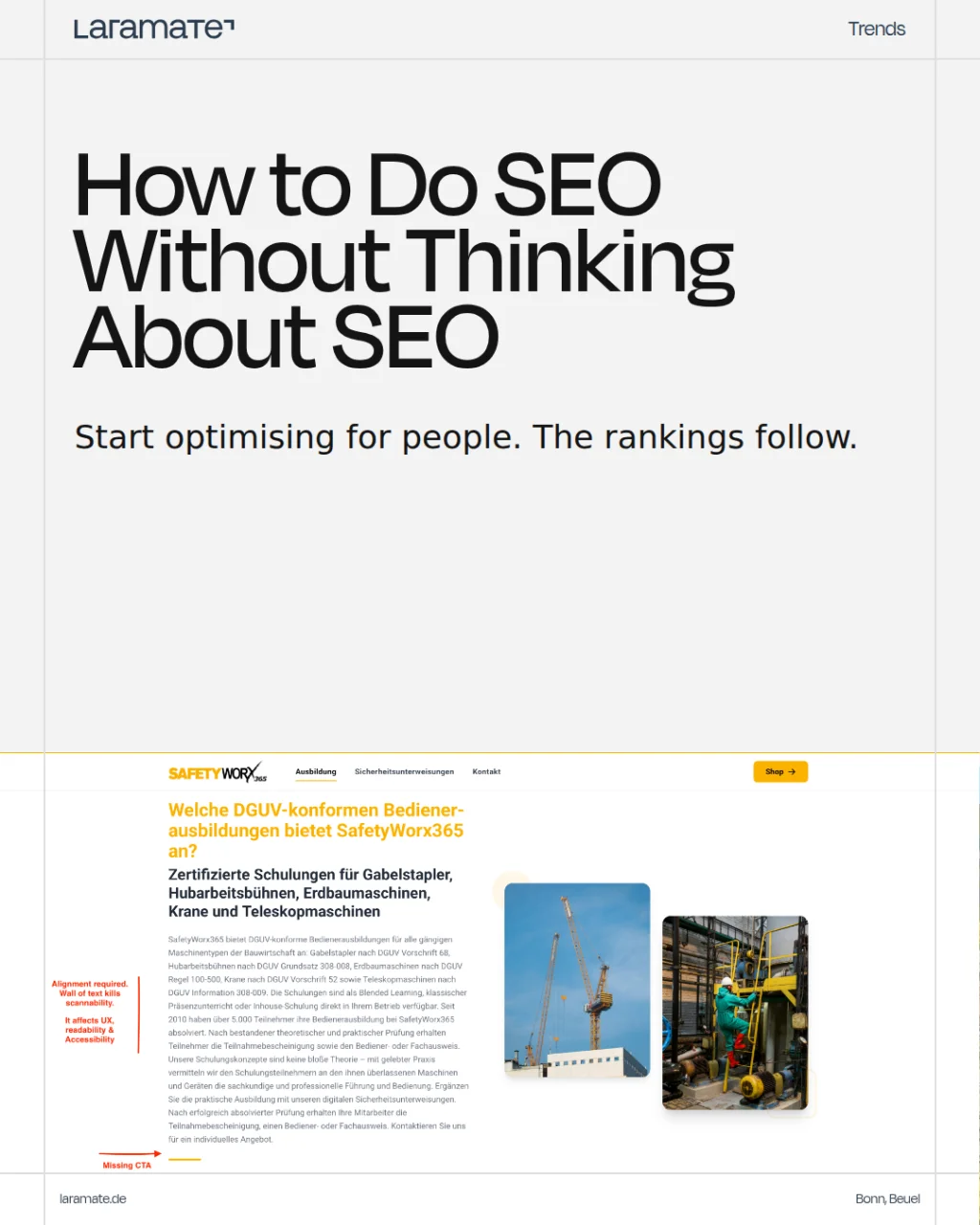
A call to action that leads nowhere.
Of course, these are not edge cases but are the kind of things that surface only when someone genuinely browses the site from start to finish, which is something many website owners simply do not do often enough. Some are even running on outdated websites and have not revisited the basics in years. This problem only increases over time as your site might grow to hundreds of pages.
As a daily habit, I browse our website by hand, unprompted. Not as a developer, but as a visitor, browsing the way a prospect would. This small practice alone has caught more meaningful issues than I can count, and I am glad to be able to spot these. My training has not been in vain. (Wink).
I take a recent example. I reached out to a CEO in my LinkedIn network after spotting a broken form on their website, sitting just before the FAQ section. The form returned an error. On top of that, the call to action appeared in the navigation bar and again at the bottom of the page, but without an actual button. The most important conversion point on the page was simply missing. I flagged it to them directly. I received no response, but I hope it was fixed.
Now ask yourself: was that normal behaviour?
Because I inquired from our in-house developer if that was. When something on your website does not look right, that is the question you should be asking. A broken form just costs you customers until someone happens to mention it. A visitor who cannot complete an action does not wait around. They leave, and they do not come back.
That same kind of issue came up this afternoon (7th of April), when I flagged a missing CTA button on a client website we are currently building. The text read “Contact us for an individual offer.” But the CTA button was missing. These things happen, and they happen more often than most people realise. The point is whether someone is paying close enough attention to catch them before the site goes live, or worse, after it already has.
Start Optimising For People. The Rankings Follow
Manual checks like this do not replace systematic SEO work but rather, sit alongside it. And understanding how that systematic side operates is worth knowing, because it shapes every decision you make about your website. Most SEO tools operate on the same principle: they crawl your website nightly, run an analysis, and flag deviations from established best practices. Those best practices are not arbitrary. They are derived from market research and from what is consistently proven to perform well in search engines.
The primary target is Google, and for a good reason.
Google commands 89.85% market share. For most businesses, absence from Google is absence from search entirely. That is no exaggeration, but the reality of where people go when they are looking for something. Bing is the second largest search engine and holds roughly 5.13% market share and warrants attention particularly in B2B contexts, where it ships pre-installed on enterprise machines and sees more consistent use. But it is not the main priority. If you have limited time and resources, you focus on Google first. Everything else follows.
For any website operating online, it is worth knowing upfront that Google publishes guidelines that define the boundaries of acceptable SEO. On one side you have white hat SEO, which operates within those guidelines. On the other hand, you have black hat SEO, which deliberately violates them. We are talking about tactics like buying links, keyword stuffing, and cloaking. These techniques artificially inflate rankings and come with a severe penalty: removal from Google’s index entirely. We operate strictly within white hat territory, and that is a conscious decision. If we are out of the game, that is not good for business, full stop.
Be Factual. Provide Value. Google Rewards Both.
Beyond these rules themselves, Google’s E-E-A-T framework: Experience, Expertise, Authoritativeness, Trustworthiness, now directly informs how its algorithms evaluate the pages it ranks. In practice, that means demonstrated expertise within your content is no longer a nice-to-have. It is a ranking input. Google is actively assessing whether the person, company or organisation behind the content actually knows what they are talking about. So if your website is publishing content that lacks depth, lacks credibility, or lacks a clear point of view, that registers. And not in your favour.
That said, the objective of SEO is to rank for the search terms your target audience actually uses. That means optimising for keywords, and there are 2 types worth distinguishing. Short-tail keywords are brief and broad, tied directly to your product or service. In our case, keywords like Statamic, ReactNative, iOS, Andriod, Laravel or Laravel agency. Then you have long-tail keywords, which are more conversational and specific, like “I want to develop an app for rating poultry in my farm.” Long-tail keywords typically have lower search volume, but they might carry significantly higher purchase intent. The more precisely a keyword matches what a prospect is trying to solve, the more valuable that conversion becomes. But this is not guesswork. You might be wondering how anyone is supposed to get inside their ideal customer’s head and know exactly what they are typing into a search bar. The good news is that you do not have to guess, because the tools to find out already exist via keyword research.
Keyword research is the process of identifying the terms worth competing for. Google Ads gives you access to search volume data. You input a list of keywords and receive estimated monthly search volumes in return.
News or no news!?
Well, it’s good to know.
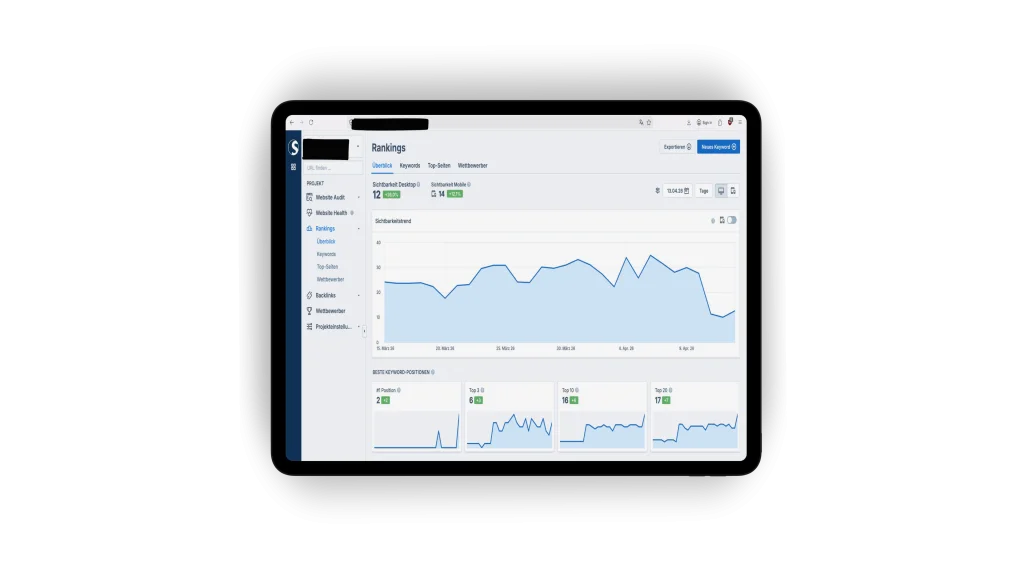
Tools like Seobility, Ahrefs, Sistrix or SEMrush go further by surfacing the rankings you already hold and identifying the gaps worth targeting. One caveat though: treat those volume estimates as directional as data is often a rough approximation of actual search behaviour, not a precise figure. Use it to guide your thinking, not make final calls.
Use What You Already Have to Attract the Right Audience
Laramate GmbH, we work with B2B clients and SMEs, and one of the ways we demonstrate our expertise is through our case studies.
Our case studies are not marketing pieces written from a brief. They come directly from the projects we have worked on, and we present them from our own perspective, especially presenting the “what,” “why,” and “how,” with the keywords that are specific to us and to what we want to rank for.
— Laramate GmbH
This distinction here matters because a B2B client presenting the same project would likely tell the story differently, using keywords specific to their industry and their own ranking objectives.
Same project, different lenses, different keyword strategies.
Case studies present a specific challenge for that reason. The topic is determined by the project itself, not by research. What you control is how you describe the work:
the technologies used,
the business problem addressed,
the industry context.
Those are the keywords you embed deliberately. Once the content is published, tools like Seobility, Ahrefs, Sistrix, or SEMrush audit it and flag issues such as insufficient keyword density or lack of topical focus. Here is my 2-cent advice: Do not dismiss those flagged issues. Treat them as areas of improvement and work through them to increase your rankings over time.
On the subject of keyword frequency, there is a formula. Let’s say, for a 1000-word page, the primary keyword should appear at a ratio above a certain threshold relative to the total word count. But optimising for that ratio alone is the wrong approach, and here is why. Language models and semantic text analysis now allow search engines to understand what a page is about through contextual reading, not by counting how many times a keyword appears. A paragraph that repeats “Laravel agency” 20 times does not read as authority. It reads as manipulation because of keyword stuffing. Don’t fall for that trap! No serious prospect evaluating a technology vendor is persuaded by that.
Credibility is built through clarity and precision, not repetition. Write for the person reading the page, not for the crawler indexing it.
— Laramate GmbH
So what does a high-performing page actually require? Let us be specific.
First, original images.
Second, a well-written copy with a clear point of view.
Third, strict topical focus. One page should cover one topic, not five.
Fourth, a structure that guides the user deliberately from the moment they land on the page.
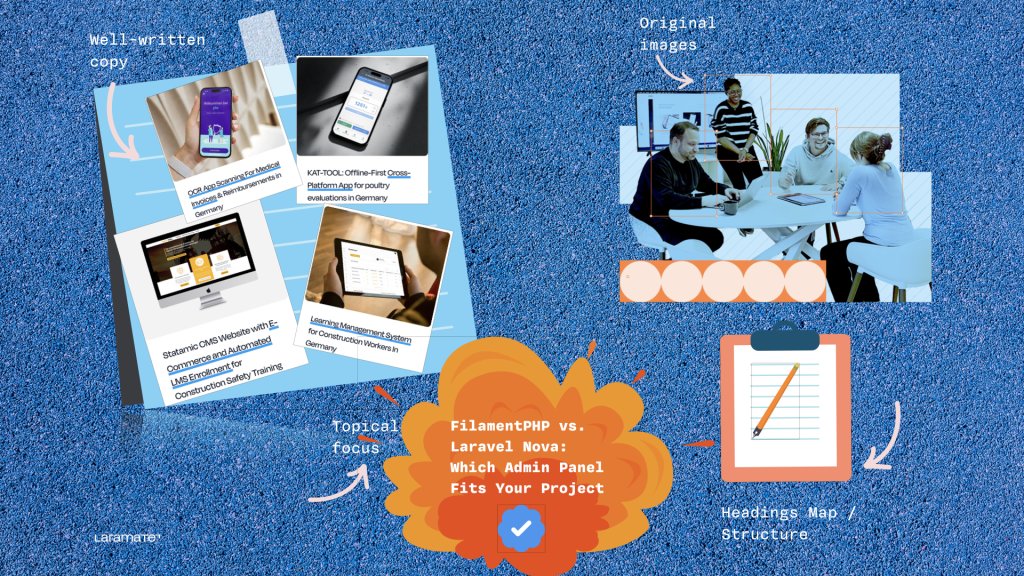
A strong page opens with a headline that frames the problem, builds the argument progressively through each section, and closes with a clear call to action. That is the architecture. SEO is simply the discipline of building that kind of page consistently, across your entire website. It is not a separate function from good web publishing. It is the standard by which good web publishing is measured.
Now, beyond content, performance is a ranking variable in its own right. Google has formalised this through what it calls Core Web Vitals - signals it uses to assess page experience. The first is Largest Contentful Paint, which measures how fast the main content on your page loads. And you have, Cumulative Layout Shift, which measures visual stability, meaning whether elements on the page jump around as it loads.
There is also mobile-first indexing to consider. Google evaluates your mobile version first. If your mobile experience is degraded, your rankings reflect that, regardless of how polished the desktop version is. And here is a figure worth sitting with: a one-second delay in page load time reduces conversions by approximately 7%. These are not abstract technical metrics. They are the difference between a visitor who completes an action and one who does not.
Structured data has also become a strategic asset, and not only for traditional search. This is where GEO comes in: Generative Engine Optimisation. GEO is a discipline that has emerged specifically because AI is now embedded in search. Google’s AI Overviews, Perplexity, ChatGPT’s browsing mode, Gemini - these systems generate answers directly from web content. Schema.org markup delivered via JSON-LD makes your content significantly easier for them to parse, attribute, and cite accurately. Practitioners who have studied this consistently find that strong SEO already satisfies most of the technical requirements for GEO. The 2 disciplines are converging, and structured data is where they meet.
For that, we have a concrete example from our own experience.
We were recommended by ChatGPT to a prospective client. We cannot attribute that to a single factor with certainty, but the mechanism is not difficult to understand.
Our website is crawled by GPT, Claude, Gemini, and other AI bots. Because we invest in SEO, those systems can parse and contextualise what we do. Our technical positioning registers as expert-level, which is precisely the signal we want to send.
Therefore, building a well-structured, technically sound, content-rich website does not just serve your search rankings. It determines how AI systems understand you and, more importantly, how they represent you to others.
Which brings us back to where we started. The practical takeaway is straightforward:
Browse your own website the way a stranger would.
Click every form.
Follow every call to action.
Check every link or slugs. Are they too long or too short?
The issues that matter most are not always surfaced by tools. Sometimes they are caught only by a fresh pair of eyes and the willingness to actually look.
So, my question to you:
Are you still operating on an outdated website? It might be running, but that is not the same as performing.
What are your conversion rates?
What is your page load speed?
Do your images take ages to appear?
How is your heading structure organised, and is it actually guiding visitors through the page the way it should?
What CMS are you using, and does it give you enough flexibility to manage your content, adjust your fieldsets, and handle your assets without calling a developer every time?
These are not trick questions. They are the baseline. And if any of them gave you pause, that is worth paying attention to.
There are no two ways around it.
Let us assess your website performance together.
No results One result
Too many searches in a short time. The search is not reachable right now.
Please wait a moment, then carry on. Please try again in a moment.