



Filament vs. Laravel Nova: Which Admin Panel is Right for You?
Filament is open source, has over 30,000 GitHub stars, and offers more than 800 plugins. Nova is the official Laravel admin panel, proven, but licensed per project. The choice between them affects the cost, flexibility, and future-proofing of your project. As an agency with Filament expertise, we compare both solutions and indicate the cases in which Nova still fits better.

For the majority of projects, especially for SMBs, agencies, and startups, Filament v5 is the better choice: open source, cheaper to operate, more flexible to customise, and with native multi-tenancy.
Nova v5 remains a solid option, particularly for teams with existing Vue.js expertise.
Choosing an admin panel is a decision that will stay with your project for years. It influences development cost, maintenance effort, flexibility when new requirements come up, and the availability of developers on the job market. Still, many comparison articles are based on outdated versions and stop at simple feature lists.
We compare Filament v5 and Nova v5.8. As an agency specialising in Filament, we use Filament in our own projects. That position informs our assessment, as it does in our other comparison articles. This article describes the points that drive our decision.
What fundamentally separates Filament and Nova?
The most important difference is not technical but strategic: Filament is open source, Nova is proprietary. This fundamental decision shapes every other aspect: cost, extensibility, and long-term viability.
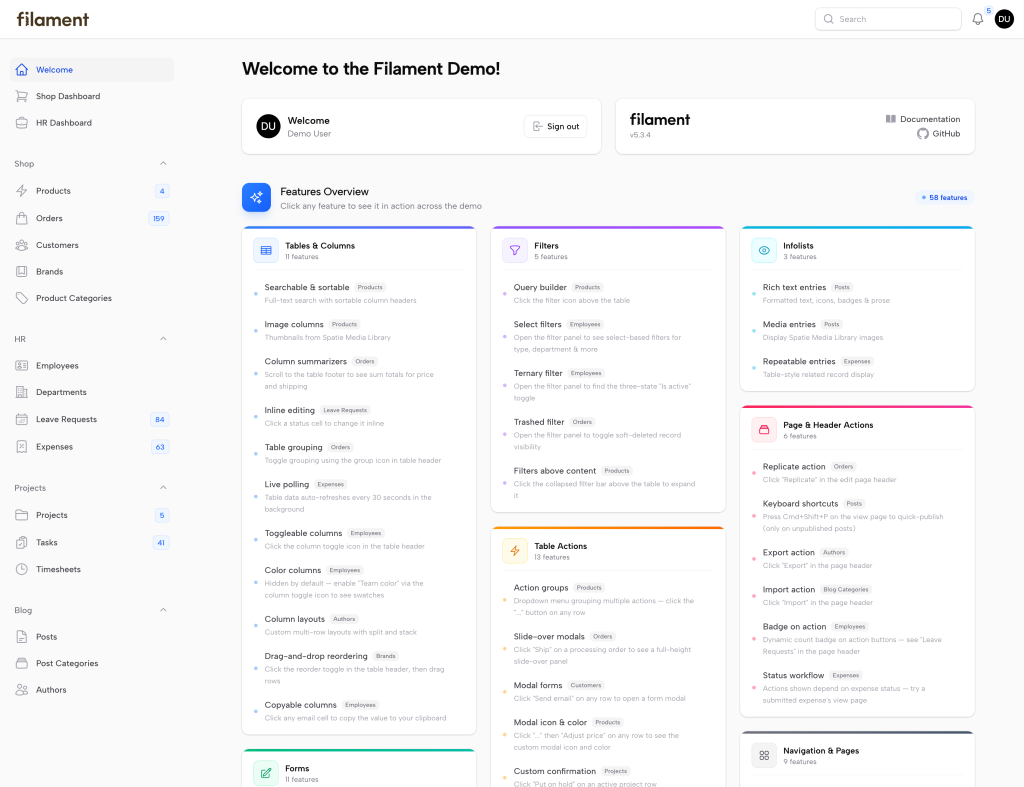
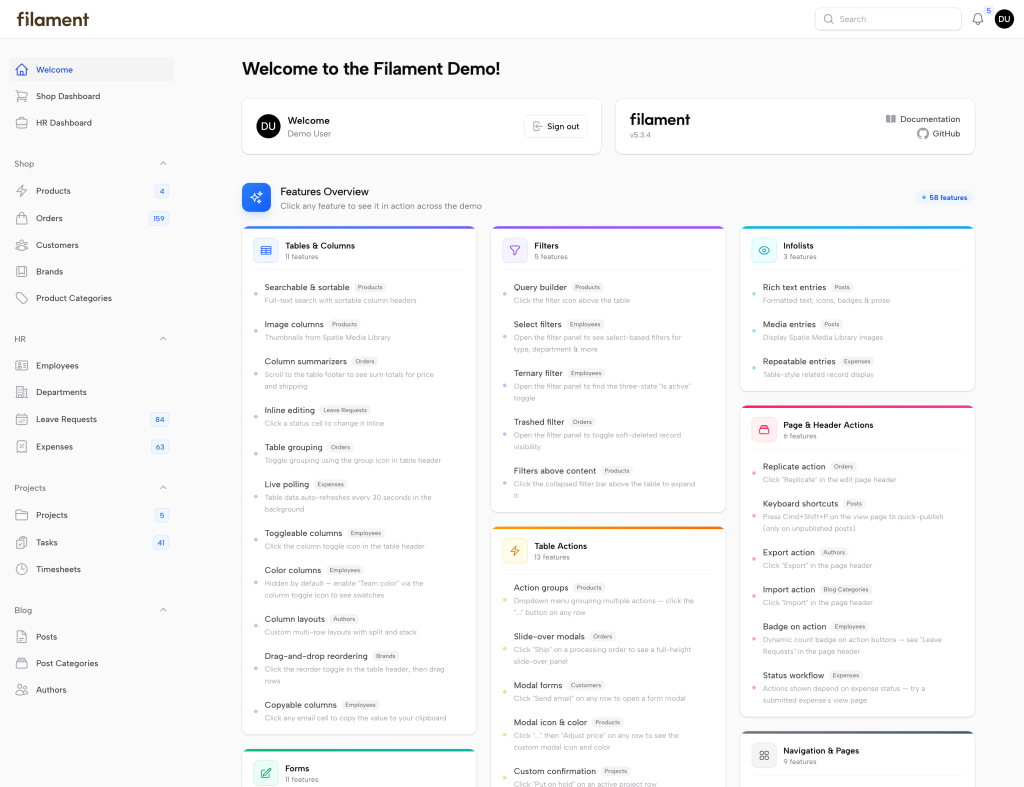
Filament is open source and MIT-licensed. The entire source code is publicly visible, you can use, adapt, and deploy it in any number of projects without paying licence fees. Development is driven by an active community of more than 350 plugin authors. You can submit pull requests, report bugs, and directly influence the roadmap. Filament can be tried immediately, without installation, through the public Filament demo.
Nova is a commercial product of Laravel LLC. The source code is only accessible via Composer installation with a valid licence. Development happens behind closed doors. There is no public roadmap, no community contributions to the core, and no way to suggest features directly. Nova also offers a public demo you can try out (login: demo@laravel.com, password: password).
The underlying question for decision-makers is this: How dependent do you want to be on a single vendor? With Filament, the community can continue the project should lead developer Dan Harrin step away. With Nova, everything depends on Laravel LLC. If Taylor Otwell were to discontinue Nova, as happened with Laravel Spark, you would lose access to updates and support.
What sets the current versions apart?
Most comparison articles on the web are outdated. They refer to Filament v3 or v4 and Nova v4. Those versions in some cases had fundamentally different feature sets. The current versions differ as follows:
Filament v5
Server-Driven UI (SDUI) as a core principle: you define your entire interface in PHP, with no separate frontend framework
AI-assisted Development: Dedicated documentation and tooling for AI-assisted panel creation, resource scaffolding, and form generation
Native Multi-Tenancy: Built-in support for multi-tenant applications, with no external packages
CSS Hooks and improved theming: More control over the visual appearance, even if within the Tailwind-based design language
More than 800 releases: Iterative development with frequent updates
Nova v5
New pricing model: approx. EUR 90 (Single Project) or approx. EUR 275 (Unlimited), each with an annual renewal fee of approx. EUR 70 or EUR 230 respectively. Nova is no longer buy-once-use-forever, but an ongoing cost
Still Vue.js-based. On top of Laravel skills, your team also needs frontend expertise
No documented AI features
No native multi-tenancy
14 first-party field types, a solid feature set, but less momentum in ongoing development
Who uses which system, and why?
The numbers show a clear trend. Filament has not only caught up with Nova in community adoption, but has overtaken it by a significant margin.
over 30,000 GitHub stars, more than 23 million Packagist downloads, over 1.7 million downloads per month, more than 800 plugins from over 350 authors, more than 800 releases, active Discord community
Not public (closed source). No GitHub stars, no Packagist statistics. Smaller plugin ecosystem, mostly paid. Official Laravel support.
Nova benefits from the official Laravel branding.
Filament has the broader community. In Laravel forums and on Reddit, the most frequently cited reasons for switching from Nova to Filament are: the per-project licence that quickly adds up for agencies, a lack of flexibility for custom UIs, and the Livewire-based development model that does not require Vue.js.
For business owners this means: if you are looking for a Filament developer, you will find a larger and growing talent pool. If you need a Nova specialist, your search narrows. Nova also requires Vue.js skills, which further restricts the pool of candidates.
What will the decision cost you over three years?
Licence fees are the smallest line item, but even they add up. Many comparisons just quote "EUR 90 vs. free" and leave it at that. The reality is more nuanced, as we have shown in our make-or-buy comparison. Here is a sample calculation for an agency equipping five client projects with an admin panel over three years:
Licences year 1: 5 × approx. EUR 90 = approx. EUR 450. Renewals years 2 + 3: 5 × approx. EUR 70 × 2 = approx. EUR 700. Plugin costs (estimated): approx. EUR 460. Total: approx. EUR 1,610.
Licences: EUR 0 (open-source core). Optional Pro package: approx. EUR 90/year. Plugin costs (estimated): approx. EUR 140. Total: EUR 0 to approx. EUR 410.
Filament projects have lower running costs, and the range of existing extensions covers more use cases out of the box. That means the available project budget can go directly into developing your product further.
Other factors that influence the cost over the lifetime of a project:
Developer onboarding: Filament uses exclusively standard Laravel technologies: Livewire, Blade, Tailwind CSS. Any Laravel developer can be productive straight away. Nova adds Vue.js as an extra technology. That is not a disadvantage if Vue.js expertise already exists in the team, but it raises the barrier to entry for pure PHP/Laravel teams.
Maintenance during major upgrades: Major upgrades involve effort with both systems, that is the reality of any framework. The key difference: Nova’s Vue.js-based custom components are more susceptible to breaking changes during major version jumps than Filament’s Blade components, which can increase the upgrade effort for heavily customised projects.
Developer availability: With over 1.7 million monthly downloads and an active community, the pool of available Filament developers on the job market is larger than that of Nova specialists. As we have shown in our Laravel vs. Symfony comparison: in Germany, developer availability is often the limiting factor, not the technology itself.
Hosting: Neither system places any special demands on hosting beyond what any Laravel project already requires.
Do you need multi-tenancy?
If so, Filament is by far the easier choice. Multi-tenancy, the ability to manage several tenants (customers, departments, locations) inside a single application, is a common requirement for SaaS products, customer portals, and platforms.
Filament v5 ships with native multi-tenancy. You configure tenant models, define access rules, and your users can switch between tenants. All of this happens inside the panel, without external packages or lengthy configuration.
Nova has no native multi-tenancy. If you want to build multi-tenant applications with Nova, you need third-party packages such as stancl/tenancy and have to configure the integration manually. That works, but it is significantly more effort. Every additional dependency is another potential maintenance point.
We have implemented multi-tenancy in several client projects, including a multi-tenant Statamic architecture. Our experience shows: native multi-tenancy not only saves development time, it also considerably reduces the complexity of ongoing maintenance.
Important to know: You are not forced to rely on a panel framework’s built-in mechanisms for multi-tenancy. For more complex requirements, such as database isolation per tenant, tenant-specific configuration, or a bespoke billing model, a custom implementation at the Laravel level can be the better choice. Filament’s native multi-tenancy covers the most common scenarios and accelerates the start. It is not a substitute for tailor-made architecture when your requirements go beyond the standard.
How important is customisation to your corporate design?
Both panels impose a strong UI, but Filament gives you more room to work with. An admin panel is not a blank canvas. Both Filament and Nova ship with an opinionated interface that you cannot fundamentally redesign. That is intentional: it speeds up development and ensures consistency.
The difference lies in the degree of customisation within those constraints:
Filament lets you write your own theme. Via CSS hooks and its Tailwind-based architecture, you can adapt colours, layouts, and components to your corporate design. This happens within strict constraints, you are not rebuilding from scratch. The end result can look significantly different from the default. For companies that want to use the panel as a customer portal or white-label solution, this is a meaningful advantage.
Nova offers more limited theming. Custom adjustments require Vue.js components, and the visual identity remains more closely tied to the standard Nova design. For an internal back office that only employees see, that is no problem. For a customer-facing interface, it can become a disadvantage.
How much effort does it take to build custom pages or form components?
With Filament, you stay inside the Laravel universe. With Nova, you need a second frontend framework. This is one of the points that makes the biggest difference in day-to-day project work, and it is missing from most comparison articles.
Filament: one PHP class, one Blade view. You create a custom form field with a single Artisan command. The result is a PHP class and a Blade template, both technologies every Laravel developer already knows. Custom panel pages are full-fledged Livewire components, too. You get access to the entire Livewire feature set without having to learn a separate framework. No build step, no JavaScript, no Webpack.
Nova: three Vue.js components plus a PHP class. A custom Nova field consists of three separate Vue.js components (for index, detail, and form) plus the PHP class. Custom pages and tools additionally require Inertia.js routing and a Webpack/Mix configuration. Your developer has to master Vue.js, Inertia, and Nova’s own build process alongside Laravel.
In practice, this difference becomes particularly painful during upgrades. The official Nova v4 upgrade guide documents that custom components had to be migrated from Vue 2 to Vue 3, Vue Router had to be replaced with Inertia.js, and Webpack configurations had to be adjusted. Filament does not have this problem, because there is no separate JavaScript framework that can change between major versions.
For decision-makers, this means: every custom component in Nova increases the maintenance effort for future upgrades. With Filament, extensions stay within the same technology stack as the rest of the application.
Can the components also be used outside the admin panel?
With Filament, yes. That is a major strategic advantage no other comparison article mentions.
Filament is built modularly. The individual packages (Forms, Tables, Actions, Infolists, Notifications, Widgets) can be used independently of the Panel Builder in any Laravel application. The official documentation explicitly describes this as "standalone" usage and lists all components that can be used separately.
What does that mean in practice? You build an admin panel with Filament and put together a complex form with validation, conditional fields, and file upload. You can embed the same form, with the same components and the same logic, inside your customer-facing frontend. Or you use the Table component for a data overview that does not live in the admin panel but in a separate customer portal.
Nova does not offer this possibility. Nova’s components are bound to the Nova panel and cannot be reused outside of it. If you need the same form logic in your frontend, you have to reimplement it there from scratch.
For companies running both an internal back office and customer-facing interfaces, this is a genuine argument: with Filament, you invest once in form and table logic and use it everywhere.
What about the plugin ecosystem?
Filament has the larger and more open ecosystem. With over 800 plugins from more than 350 authors, Filament offers a wide range of extensions, most of them free and open source. On filamentphp.com/plugins you will find a searchable registry with plugins for media management, roles and permissions, import/export, audit logging, notifications, and much more.
Nova has a smaller ecosystem. Many third-party plugins are paid, and there is no comparably transparent, central registry. The quality of the available plugins is generally good, but the selection is more limited.
Which features does Filament have that Nova is missing?
Filament offers a range of features that are either missing from Nova or can only be implemented via third-party plugins and custom code. The following overview focuses on the points that make the biggest difference in day-to-day project work, sorted by business relevance.
Standalone use of components
Forms, Tables, Notifications, and other packages can be used outside the admin panel in any Livewire component. With Nova, all components are bound to the panel. This point has its own section above, because it is a decisive argument for projects with customer-facing interfaces.
Arbitrary data sources, not tied to Eloquent
Filament can display and process data from any source, not just Eloquent models. You can hook up external APIs, CSV files, Elasticsearch indices, or any other data source and render them via Filament’s Table and Form builders. That turns Filament into an interface for your entire system landscape, not just your database. Nova is architecturally tied to Eloquent: every resource is based on an Eloquent model. If your data comes from an external API or a non-database backend, you quickly hit the limits of Nova.
Multiple panels in a single application
Filament allows multiple independent panels in the same Laravel application, for example an internal admin panel and a separate partner or customer portal, each with its own resources, roles, and design.
Wizard (multi-step forms)
Filament offers native multi-step forms as a form component. Complex input processes such as an order entry flow or an onboarding flow can be broken up into manageable steps without custom code.
Builder field (content builder)
Filament includes a native builder field type, allowing you to define repeatable block structures, similar to a page builder. Users can compose different block types (text, image, video, call-to-action) in any order. Ideal for content management or richer forms.
Dashboard filters with session persistence
In Filament you can define dashboard-wide filters that affect all widgets simultaneously. For example, a date filter that filters the revenue widget, order overview, and chart all at once. Filter settings are preserved across page reloads.
Multiple dashboards
Filament supports multiple dashboard pages with their own URLs, widgets, and access rights, for example a finance dashboard, an operations dashboard, and a management overview. Nova is limited to a single dashboard.
Advanced table features
Filament tables natively offer features that are missing from Nova or only available via plugins: drag-and-drop reordering of records, grouping by columns, columns that end users can show and hide, and a query builder for complex nested filter conditions.
Mobile optimisation
Both panels are fundamentally responsive. Tables, forms, and navigation adapt to smaller screens. The difference: Filament offers dedicated APIs for mobile optimisation. Action buttons can automatically turn into icon-only buttons below a defined breakpoint, the sidebar can be made collapsible on desktop via configuration, and all components are designed from the ground up for touch input. If your users regularly use the admin panel on a tablet or smartphone, for example in the field, on a construction site, or in a warehouse, Filament offers the more thoughtful mobile experience.
Render hooks
Filament provides dozens of defined entry points (render hooks) where you can inject your own content into panels, tables, and forms, without overriding the original components. This makes customisations significantly more maintainable than in Nova, where customising often requires deep, invasive changes.
To put this in context: Not every project needs all of these features. They do show a fundamental difference in direction: Filament is designed as an extensible framework, while Nova is focused on being a pure admin panel. The more individual your requirements, the more Filament’s approach pays off.
What role does AI play in development?
Filament embraces AI-assisted development. Filament v5 ships with dedicated AI documentation that describes how AI tools can support panel creation, resource generation, and form configuration. This lowers the barrier to entry and speeds up development, especially for standard tasks such as CRUD interfaces and dashboards.
Nova v5 has no comparable AI features documented or advertised.
For decision-makers this matters, because AI integration is no longer a gimmick but a direct driver of development speed and therefore time-to-market. A panel framework that actively supports AI tools reduces development cost, regardless of whether your team works in-house or externally. We have described how AI is reshaping software development more broadly in our article on automation.
When is Nova still the better choice?
Your team has strong Vue.js expertise and wants to put it to use. If Vue.js is already a fixed part of your tech stack and your developers prefer building custom components in Vue, Nova integrates more seamlessly than Filament.
What we do not consider decisive advantages:
"Official support from Laravel LLC" sounds reassuring, but in practice it is rarely the decisive factor. In a real emergency, a critical bug at 10 p.m. on a Friday, no framework vendor will help you. A specialised Laravel agency like ours is available to you outside business hours. Support quality depends on your partner, not on the framework.
"Faster initial implementation" is a myth. Filament is installed and ready in under five minutes. Configuring a first resource takes roughly the same time with both frameworks. The difference only shows up with custom requirements, and there Filament is faster and more flexible.
When should you choose Filament?
Filament is the better choice in most of the scenarios we see in our project work:
You are developing several projects. For agencies and companies with multiple products, Nova’s per-project licences quickly multiply. Filament costs nothing, whether it is one project or fifty.
Multi-tenancy is a requirement. SaaS products, customer portals, platforms with multiple tenants: Filament’s native multi-tenancy saves weeks of development time.
Customisation to your corporate design matters. When the panel is also visible to end customers, Filament offers more theming options than Nova.
Your team works with the standard Laravel stack. Livewire, Blade, Tailwind CSS: if those are your tools, Filament is the natural extension. No Vue.js required.
Budget and cost control matter. Whether you are a startup or an established company: no licence fees, a large free plugin ecosystem, and faster onboarding noticeably reduce the total cost of ownership.
Open source and code transparency are strategically important. You want to be able to inspect, fork, and adapt the code, without depending on a single company.
Are there further alternatives to Filament and Nova?
Filament and Nova dominate the Laravel ecosystem, but they are not the only options. Two other projects deserve a brief mention.
Orchid Platform
Orchid follows a different approach: instead of pre-built CRUD interfaces, it relies on so-called "Screens", a kind of controller-view hybrid that offers more flexibility when designing admin interfaces. For projects that deviate strongly from standard CRUD, that can be an advantage. The community, however, is significantly smaller than Filament’s or Nova’s, and the plugin ecosystem is limited.
Backpack for Laravel
Backpack has existed since 2016 and was for a long time one of the most popular solutions for Laravel admin panels. It offers a solid CRUD system, a modular architecture, and an active community. Backpack uses a dual-licence model: free for non-commercial use, paid for production projects.
Why we do not recommend these alternatives
Both projects are functional, but for production projects we see increased risk. Their communities are many times smaller than Filament’s, development is less predictable, and the availability of developers with experience in these tools on the job market is significantly more limited. When a framework depends on a handful of maintainers and the user base stagnates, a project pivot or a missed update can quickly become a problem.
Our recommendation
We work exclusively with Filament and no longer offer Nova support.
This is not a decision against Nova as a product, but a conscious decision in favour of the framework that delivers the greater value to our clients.
The reasons are spelled out in detail throughout this article: Filament offers native multi-tenancy, standalone use of its components outside the panel, arbitrary data sources instead of Eloquent binding, multiple panels in a single app, persistent database notifications, multi-step forms, a content builder, dashboard filters, advanced table features, and render hooks.
On top of that: Filament extensions consist of a PHP class and a Blade view. With Nova, you need three Vue.js components plus a Webpack configuration, all of which can break with every major upgrade.
The numbers confirm this assessment: over 30,000 GitHub stars, more than 23 million downloads, over 800 plugins from more than 350 authors, and AI-assisted development. Filament has overtaken Nova in community adoption, and the trajectory shows where development is heading.
For our clients that means: lower licence costs, faster onboarding of new developers, easier maintenance, and a framework that scales with their requirements, from a simple admin interface to a complex multi-tenant platform. These are the arguments that tip the balance for us. Read more on our FilamentPHP page.
Are you planning a project with an admin panel, a customer portal, or an internal management interface? Talk to us. We will show you what is possible with Filament.
No results One result
Too many searches in a short time. The search is not reachable right now.
Please wait a moment, then carry on. Please try again in a moment.