


Laravel Development for SMEs: Custom Business Software For Internal Systems
SMEs, your business needs custom business software for internal systems, software that blends into your existing workflows and processes.
Maybe your team is still managing orders across scattered Excel files and endless email chains. Maybe your ERP handles most of the operation but cannot support one critical workflow. Or perhaps your customers need a dedicated client portal, your employees require a tailored internal application, or several systems need to exchange data automatically and reliably.

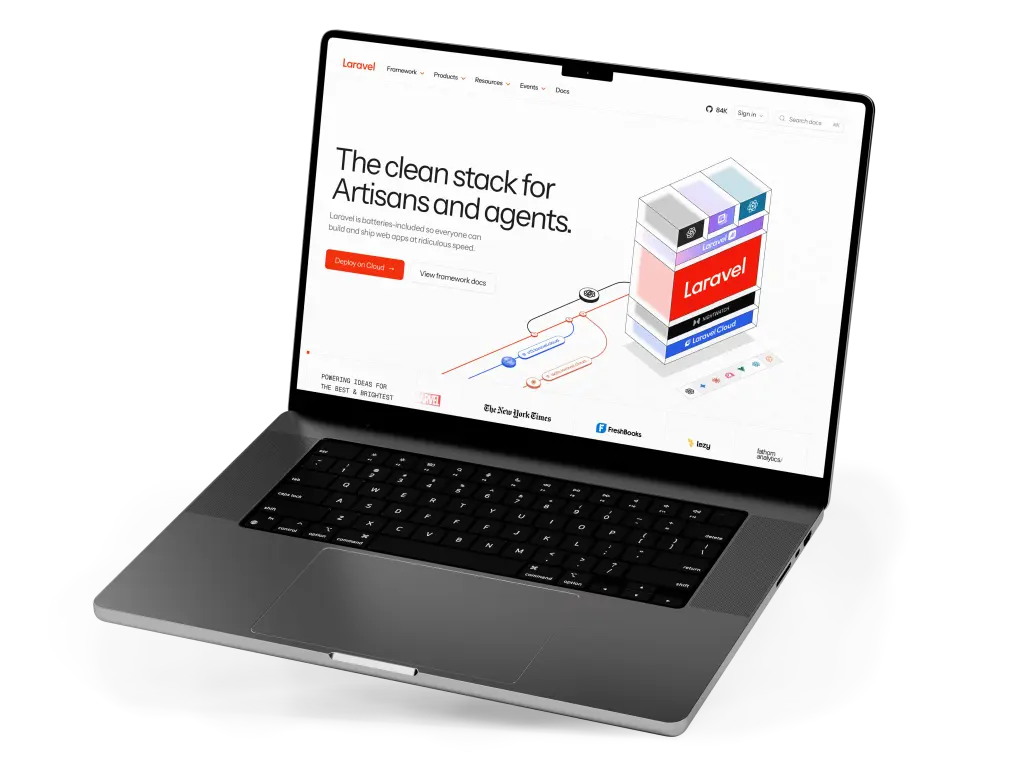
At some point, configuring another off-the-shelf tool stops solving the problem. And that's when custom business software becomes worth considering.
But what should you build it with?
For many small and medium-sized businesses (SMEs), Laravel is a pragmatic foundation for custom software because it provides a mature framework for building secure, maintainable web applications while leaving the business-specific logic flexible.
But choosing Laravel should not be the starting point. Rather, the starting point should be finding a reliable service provider using a robust technology to solve your business’ specific problems.

When should an SME consider custom business software?
Custom software does not make sense for every business.
If an existing SaaS product already handles your requirements well, buying and configuring it will usually be faster and less expensive than building something from ground up. Custom development becomes more interesting when the software itself needs to reflect how your business operates.
You may be a good candidate for custom business software if:
your ERP or CRM cannot model an important business process;
employees rely heavily on Excel for operational work;
the same information is entered manually into several systems;
your team works around limitations in standard software every day;
you need a customer, partner or employee portal with specific functionality;
several existing systems need to exchange information;
your business has workflows that are difficult to represent in standard software;
an existing application has become difficult or expensive to maintain;
you need software that can evolve with your business rather than adapting your business to the software.
Custom software reverses any software that force your business to work around it. It changes your processes to fit the software, and the software is designed around the process.
What does custom Laravel development mean?
Laravel is an open-source PHP framework used to build web applications. For a business decision-maker, however, the technical definition is less important than what Laravel allows a development team to build.
A Laravel application can provide the foundation for:
business applications;
customer and partner portals;
CRM systems;
order management systems;
SaaS platforms;
internal tools;
workflow applications;
dashboards and reporting systems;
API-driven applications;
integrations between existing systems;
industry-specific software.
The framework takes care of much of the technical foundation required by modern web applications, allowing developers to spend more time implementing the business logic that makes your application unique.
You are not paying a development team to reinvent authentication, database interactions, permissions, queues or other common application functionality.
Your budget can instead go towards the parts that differentiate your business.
Why choose Laravel for custom business software?
Laravel is not automatically the right technology for every project. But when a business needs a bespoke web application with complex workflows, integrations and room for future development, it offers several practical advantages.
Here are 5:
You don't have to reinvent the wheel
Every custom application needs a technical foundation.
Users need to log in. Permissions need to be managed. Data needs to be stored. Notifications need to be sent. Background processes need to run. APIs may need to communicate with other systems. Laravel already provides mature solutions for many of these recurring requirements out of the box.
That means development can focus on your actual business problem instead of rebuilding basic application infrastructure.
For an SME, this is more of an efficient use of the development budget.
Laravel works well for complex business logic
Business software is rarely a collection of forms.
Robust applications often need to handle:
different user roles;
approval processes;
automated notifications;
conditional workflows;
calculations;
permissions;
reporting;
document management;
integrations;
recurring tasks;
audit trails;
business-specific rules.
Here, a framework such as Laravel becomes useful. The technology already provides the foundation.
Development can happen incrementally
One of the advantages of custom software is that you don't have to build everything at once. A well-structured project can start with the most important workflow, validate it with real users and then expand on features.
For example:
Phase 1: digitise the core workflow
Phase 2: connect existing systems
Phase 3: introduce automation
Phase 4: add customer or partner access
Phase 5: expand reporting and additional workflows
This approach reduces the risk of spending a large budget before discovering the loopholes during development. It also gives business stakeholders the opportunity to test working software rather than approving an abstract specification.
The application can grow with your business
Your business processes will change.
New employees join. New products are introduced. Customers request different services. Regulations change. New systems are adopted. The software therefore needs to be maintainable and extensible.
Laravel's mature ecosystem and conventional application structure can provide a solid foundation for long-term development when the application is properly architected. The important qualification is properly architected. A framework cannot compensate for poor software engineering.
You can integrate it with your existing systems
Custom software rarely exists in isolation.
An SME may already use an ERP, CRM, accounting system, e-commerce platform or other specialist software.
But you are not asking:
"Can we replace everything?"
Rather:
"Can we build the missing layer and connect it to what we already have?"
Laravel can serve as a backend for applications that communicate with existing systems through APIs and other interfaces. This makes it possible to build around your current infrastructure instead of automatically replacing it.
For example, Laramate GmbH currently develops bespoke Laravel backends that connect business applications with systems such as Microsoft Dynamics 365 Business Central, HubSpot and custom databases.
What can you build with Laravel?
The most useful way to understand custom Laravel development is not by looking at the framework's features. Look at the business problems it can solve.
Custom order management software
If orders currently move between email, spreadsheets and several disconnected systems, a custom order management application can bring the workflow into one place.
Depending on the requirements, that could include:
order entry;
customer information;
status tracking;
automated notifications;
approvals;
document generation;
reporting;
ERP integration;
role-based access.
The goal is not simply to create another order management system but to digitise the specific way your business handles orders.
Customer and partner portals
A customer portal can give clients secure access to the information and services they need without requiring employees to handle every request manually.
For example:
orders;
documents;
project status;
requests;
account information;
support cases;
appointments;
invoices;
product information.
A custom portal becomes particularly useful when an off-the-shelf customer portal cannot accommodate your workflows or integrate properly with your existing systems.
Internal business applications
Many SMEs have important operational processes hidden inside spreadsheets, email inboxes and shared folders. An internal web application can bring those processes into a structured system.
Instead of:
Excel → email → manual check → another Excel file → employee update
you can create:
Input → workflow → automated processing → approval → notification → reporting
CRM systems
A standard CRM works well when your sales and customer-management process resembles the process it was designed to support. But some organisations have highly specific requirements.
For that, a custom CRM can model:
specialised customer structures;
unusual sales processes;
industry-specific workflows;
complex permissions;
custom reporting;
integrations;
customer portals.
SaaS platforms
Laravel can also be used as the foundation for commercial software products. If your business wants to build its own SaaS platform, Laravel can provide the backend architecture for user management, subscriptions, permissions, APIs, workflows and other application functionality, as earlier mentioned. The same principle applies here. The technology serves the product, not the other way around.
Learning management systems (LMS)
Not every organisation needs a generic LMS.
A training provider, association or company may require a learning platform built around its own courses, users, certifications, workflows or reporting requirements. A custom Laravel application can provide the foundation for such a platform when existing LMS products cannot accommodate the required process. Here is a good example of an integrated LMS we built for construction workers.
Industry-specific applications
Some business problems are too specific for a generic software product to address effectively.
For example, Laramate GmbH developed the KAT TOOL, an offline-first application for KAT e.V. that supports poultry-welfare compliance workflows, barn locations and a mandatory evaluation cycle.
Custom software becomes valuable when the underlying process is specific enough that generic software no longer fits.
What if your existing software ALMOST WORKS?
This is one of the most common situations.
You may not need a completely new system. Perhaps your ERP handles 80% of the process, or your CRM handles customer data, or your accounting software handles invoices. But the remaining 20% is being managed manually. That missing 20% may be where most of your operational friction lives.
So, before replacing your entire software stack, consider whether you can:
configure the existing system;
integrate another tool;
extend the existing application;
build a custom application around it.
Because custom development should not automatically mean replacing everything. The best solution in such cases is a new application that sits between your existing systems and connects the pieces.
It is usually cheaper to buy a mature product when your requirements are standard and the product already solves your problem. However, there comes a point where configuration becomes a workaround.
You may find yourself:
maintaining spreadsheets alongside the software;
manually transferring data;
exporting and importing CSV files;
asking employees to follow complicated workarounds;
paying for features you don't use;
building processes around software limitations;
relying on one employee who knows how everything works.
At that point, the apparent low cost of standard software can become misleading. And to be honest, how much is the workaround costing the business?
That includes employee time, errors, delays, duplicated data, missed opportunities and the cost of maintaining several disconnected tools.
Standard software or custom software: which should you choose?
This is an age-old questions and there is no universal answer. A useful starting point is this:
| Standard software may be better when... | Custom software may make sense when... |
| Your process is relatively standard | Your process is highly specific |
| The software already meets your requirements | Important requirements are missing |
| Configuration solves the problem | Configuration creates workarounds |
| Integrations already exist | Critical integrations are missing |
| Your software is not strategically important | The software supports a competitive process |
| You want the lowest initial investment | Long-term flexibility is important |
| You don't need extensive customisation | You need control over the workflow |
The goal is not to build custom software because custom software sounds sophisticated. The goal is to choose the solution with the best balance of cost, control, flexibility and business value.
How much does custom Laravel development cost?
A small internal tool with a few workflows is fundamentally different from a multi-user platform with several integrations, complex permissions and data migration.
The cost depends on factors such as:
number of users;
number and complexity of workflows;
business logic;
integrations;
existing systems;
data migration;
authentication and permissions;
reporting requirements;
mobile requirements;
compliance requirements;
testing;
infrastructure;
ongoing maintenance.
This is why asking:
"How much does a Laravel application cost?"
is usually less useful than asking:
"What problem are we trying to solve, and how complex is the solution?"
A good development partner should be able to break that complexity down before asking you to commit to a large build.
How to reduce the risk of a custom software project
Choosing Laravel is only one part of the decision. The development partner you choose can have a much greater impact on the outcome.
Custom software projects can fail because of:
unclear requirements;
poor architecture;
insufficient discovery;
underestimating integrations;
weak project communication;
inadequate testing;
poor documentation;
inexperienced development;
unclear ownership;
building too much before validating the core workflow.
This is particularly important for SMEs because a failed software project is not simply a technical problem. It can consume budget, management attention and months of operational time. A development partner should therefore be able to explain not only how they will build the application but why the proposed architecture and scope make sense for your business.
A significant share of our incoming projects were not greenfield projects. They are rescue missions. In some cases, companies whose previous developer disappeared. Codebases that the internal team could no longer change safely. Stalled projects burning budget every month with no end in sight. We’ve seen the same pattern dozens of times. The cost of rescuing a stalled project is typically 2 - 3x the cost of building it correctly the first time.
Cheap is expensive. Remember, saving 30% on the initial build becomes a poor trade if it costs you the project.
What should you ask a Laravel development agency?
Before choosing a Laravel development company, ask questions that go beyond the framework. Look at past projects, ask about architectural decisions, and talk to references.
In other words:
Can they show 3 SME projects of similar scope in production today?
Can they explain architectural decisions in language a non-developer understands?
Do they offer a fixed-price discovery phase before committing to the full build?
Are references reachable, or only listed on a website?
Do they document the codebase to a standard a second agency could pick up tomorrow?
What happens after launch? Ask about maintenance, Laravel and PHP updates, security, monitoring, support and future development.
Why work with Laramate GmbH for custom Laravel development?
Laramate GmbH is a Germany-based software agency and Laravel specialist based in Bonn. The agency develops custom software for SMEs and B2B/B2B2C businesses and also takes over existing Laravel projects. We take on Greenfield and Brownfield projects. Our team is:
Senior-led development. Every project is led by a senior architect. As a matter of fact, when speaking to our CEO, you are speaking to the Senior Developer himself. No middleman.
New applications and legacy system projects. Laramate works on both greenfield applications and existing systems (brownfield legacy systems) that need continued development, modernisation or support.
Fixed-price discovery sprint. You see code, architecture, and a working prototype before committing to the full project budget. We agree and move forward to save time, money and resources.
Hosting in Germany or the EU. DSGVO-compliant by default, no proprietary cloud lock-in. This is important to our clients - knowing where their data is stored.
Vendor independence is a non-negotiable principle for us. Every codebase we ship is documented to the standard a second agency can continue tomorrow. We are happy our client has not only ownership of their codebase but can confidently take it forward to the next agency or in-house team if for some reason they decide to move away.
Your query might not be:
"Is Laravel the best technology?"
But:
"What technology gives us the most sensible way to solve this particular business problem?"
And that is important.
For businesses or organisations that need custom web applications, complex workflows, integrations and long-term maintainability, Laravel is often a strong candidate.
But the technology should follow the requirements.
Bottomline, if your business is struggling with software that almost works, but has spreadsheets with disconnected systems or workflows that require too much manual intervention, the answer may not be another SaaS subscription. It may be time to consider custom business software. You can build the application around your processes, integrate it with your existing systems and extend it as those processes evolve.
Have a business process that your current software can't handle?
Tell us what is currently slowing your team down.
We can help you assess whether you need a new application, an integration, an extension of your existing software or something else entirely.
Discuss your software project with us.
Or explore our Laravel development services and case studies to see how we approach custom business software.
No results One result
Too many searches in a short time. The search is not reachable right now.
Please wait a moment, then carry on. Please try again in a moment.